
Mastering Legal Problem Questions: How to Use the IRAC Method for Top Marks
Legal problem questions can be intimidating. All those facts, all that law—and no clear starting point. If you've ever stared at one and thought, "How do I even begin?" you're not alone.
The good news? With a solid structure, they transform into one of the most rewarding ways to show off your legal thinking. At LawTutorPro, we teach students how to break down complex legal scenarios with clarity and confidence—starting with one of the most powerful tools in your writing arsenal: the IRAC method.
📘 Legal Problem Questions
Problem questions are different from essays. Instead of discussing a legal issue abstractly, you’re asked to advise the parties in a fictional dispute.
Essays are discursive.
Problem questions are applied.
Think of them as a legal puzzle. Every fact is a clue. Your job is to find the legal consequences.
🧩 Step 1: Spotting the Legal Issues
Start by reading the scenario slowly—twice. Read the problem once quickly for context and initial reaction. On the second reading, highlight key facts.
Ask yourself:
Who’s involved?
When did events occur?
What’s the conflict?
What areas of law are relevant?
💡 Tip: Key phrases often signal legal turning points.
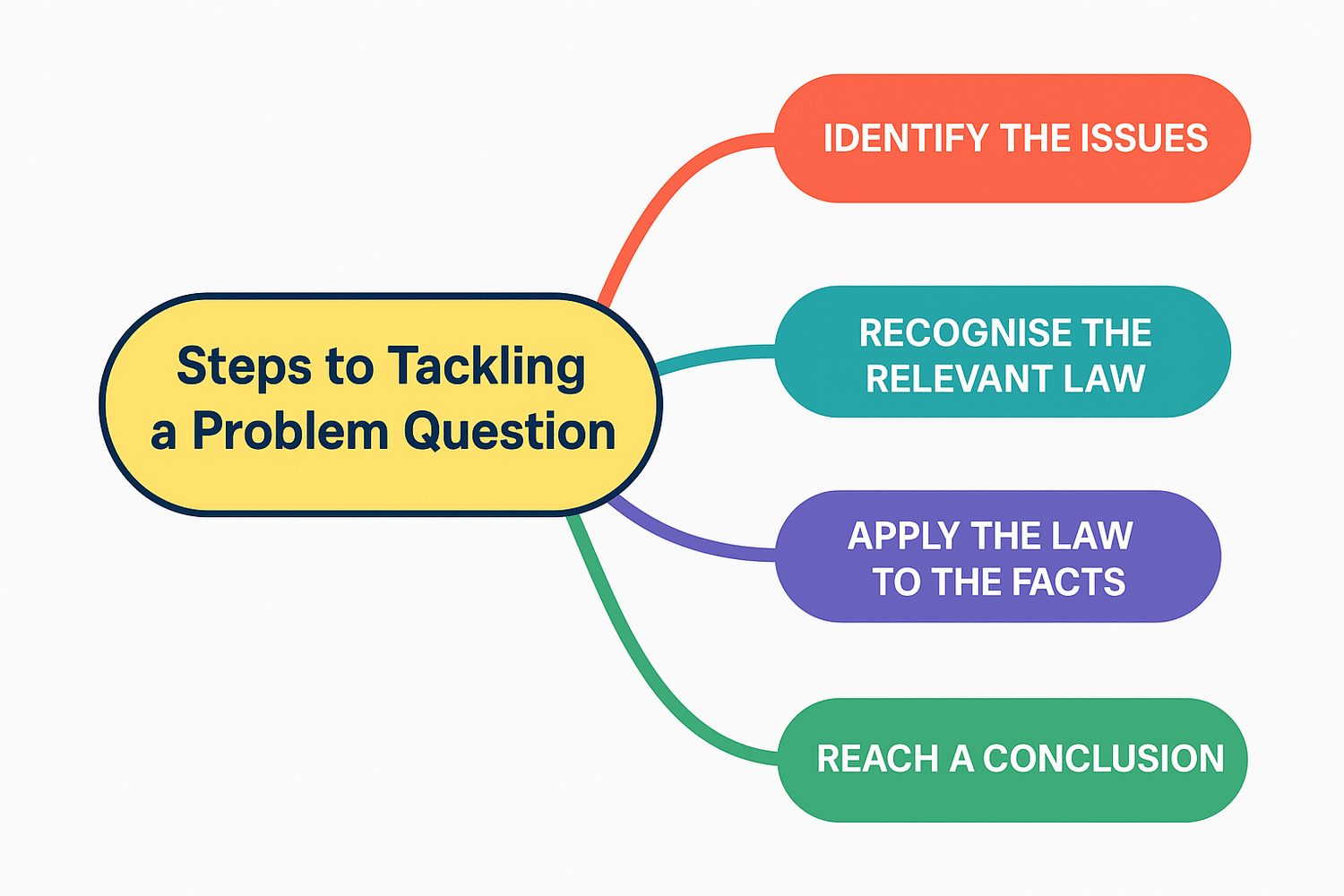
⚖️ Step 2: IRAC—Your Legal Answer Blueprint
IRAC stands for:
Issue
Rule
Application
Conclusion
Here’s how to apply each step to this Land law scenario on Fixtures and Chattels:
Pontypandy Local Authority is the registered proprietor of a plot of land beside the Pandy River which it wants to redevelop as a library and arts centre (the white area in the diagram). The Local Authority has left the plot unused for many years.
The Local Authority has sold Area 1 of the plot (the grey area in the diagram), which contains a building that was the Riverside Hotel, to Xu. The Hotel has been abandoned for many years, but still contained many original features, including statuary in the garden and original Art Deco reception and bar fittings.
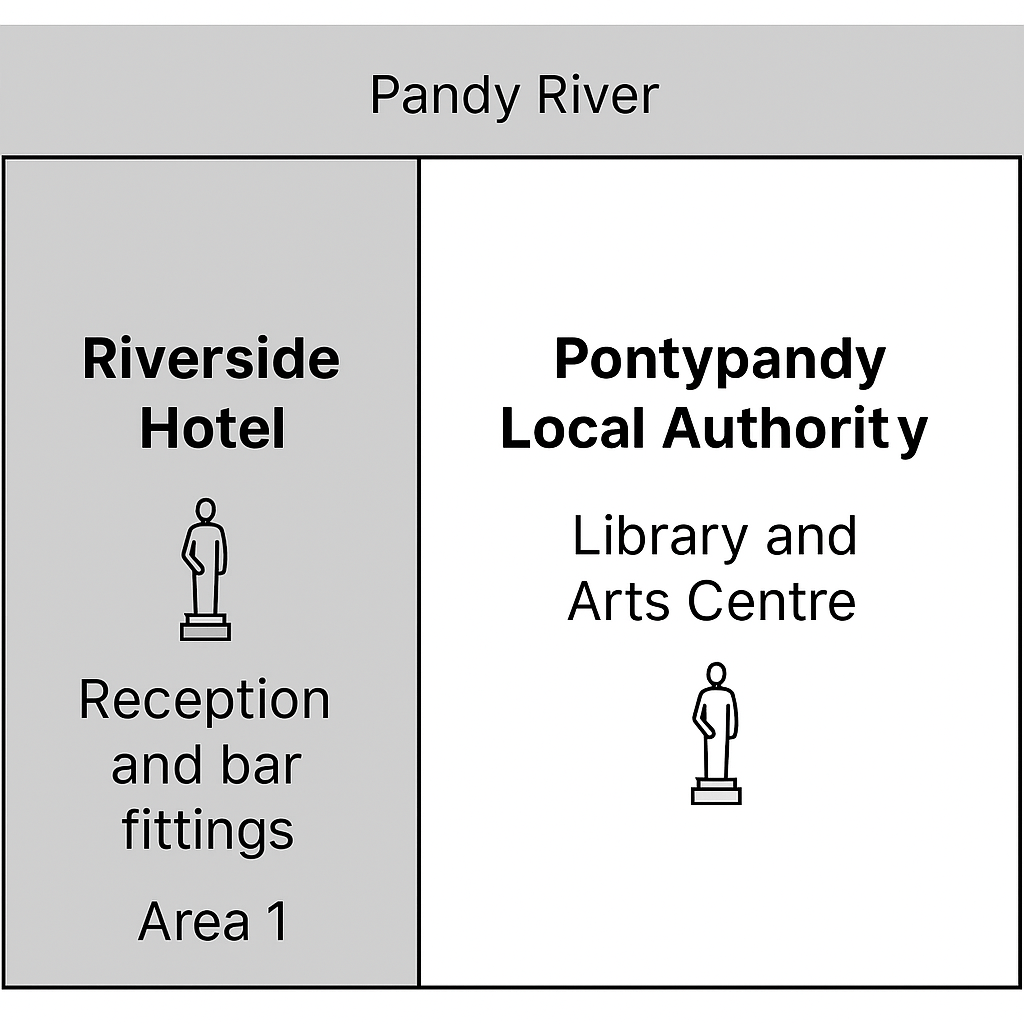
Contracts for the sale to Xu were exchanged on 28 November 2021. As a result of an administrative mix-up, on 29 November 2021, workers for the Local Authority stripped the Hotel of its reception and bar fittings and removed the statues from the garden. The sale was completed on 30 November 2021.
Advise Xu on the legal position with regard to the internal fittings and the statues. He wants compensation for their loss.
🧩 Step 1: Spotting the Legal Issues
💡 Initial Reaction (first reading): This is a fixtures vs. chattels problem and a trust/equity issue — key doctrines will be annexation tests and Lysaght v Edwards
💡Reread and Highlight Key Facts (second reading): While reading again, underline or mentally note the key facts.
Pontypandy Local Authority [seller] is the registered proprietor of a plot of land beside the Pandy River which it wants to redevelop as a library and arts centre (the white area in the diagram). The Local Authority has left the plot unused for many years.
The Local Authority has sold Area 1 of the plot (the grey area in the diagram), which contains a building that was the Riverside Hotel, to Xu. [buyer] The Hotel has been abandoned for many years, but still contained many original features, including statuary in the garden [Are they part of the land or removable? Think D’Eyncourt] and original Art Deco reception and bar fittings [Possibly fixtures – may be built-in or integral to design]
Contracts for the sale to Xu were exchanged on 28 November 2021. [Xu acquires equitable interest from this point (Lysaght)]. As a result of an administrative mix-up, on 29 November 2021, workers for the Local Authority stripped the Hotel of its reception and bar fittings and removed the statues from the garden. [Did this breach their duty as trustee?] The sale was completed on 30 November 2021. [Legal title transferred – Xu missed the items by 1 day]
Advise Xu on the legal position with regard to the internal fittings and the statues. He wants compensation for their loss.
⚖️ Step 2: IRAC—Your Legal Answer Blueprint
🔍 I – Issue
State the precise legal issue.
Example:
Removal of Internal Fittings and statues
Was the Local Authority legally entitled to remove the reception/bar fittings and garden statues from the Riverside Hotel after exchange of contracts but before legal completion?
Be specific. Vague issues lead to vague answers.
📜 R – Rule
Outline the relevant legal principle, including:
Statutes
Case law
Legal tests
Example:
Under English land law, the classification of items as fixtures or chattels determines whether they pass with the land. The leading case, Holland v Hodgson (1872), established the two-stage test:
Degree of annexation – the more firmly an item is attached, the more likely it is a fixture.
Purpose of annexation – if the item is intended to enhance the land or building, it is likely a fixture; if for temporary or personal use, it is likely a chattel.
This has been applied and refined in case law such as Botham v TSB Bank plc [1997]; Elitestone Ltd v Morris [1997]; D’Eyncourt v Gregory (1866) and Re Whaley [1908].
In Lysaght v Edwards (1876), it was held that once contracts are exchanged, the buyer acquires an equitable interest in the land and the seller holds the property on trust for the buyer. The seller must not take actions that diminish the property’s value before completion..
🧠 A – Application
Apply the law directly to the facts:
Break down each legal element.
Compare with case law.
Explore multiple angles if needed.
This is where strong answers stand out—because this is where you argue like a lawyer and where most of your marks will be awarded.
Example:
1. Reception and Bar Fittings
These fittings were part of the original Art Deco design and likely integrated into the structure of the Riverside Hotel. Under the degree of annexation test, if they were bolted in or fitted into walls or counters, they are physically part of the land. Under the purpose test, their aesthetic and functional role in defining the hotel’s character supports a classification as fixtures. This aligns with Botham where built-in kitchen and bathroom units were fixtures, and Elitestone, where a chalet’s inseparability from the land meant it was part of it.
2. Garden Statues
The garden statues, if placed as part of the original landscaping or aligned with the historic or stylistic vision of the hotel, may qualify as fixtures under D’Eyncourt v Gregory, which recognised statues integrated into a property's overall architectural scheme. If merely resting and movable, they could be chattels. But if set on plinths or forming part of the designed garden (as in Re Whaley), they would likely be considered fixtures.
3. Timing and Xu’s Rights
Contracts were exchanged on 28 November 2021, which gave Xu an equitable interest. The Local Authority removed the items on 29 November, before completion on 30 November. Under Lysaght v Edwards, the seller becomes a trustee post-exchange and has a fiduciary duty not to interfere with the property’s value. Removing fixtures during this period amounts to a breach of that duty and undermines the buyer’s equitable interest.
✅ C – Conclusion
Finish each IRAC with a short, confident conclusion.
Example:
Therefore, the Local Authority was not entitled to remove the reception/bar fittings or the garden statues. Both are likely to be classified as fixtures using the tests from Holland v Hodgson and subsequent case law. Xu had an equitable interest from the date of exchange, and the seller’s actions likely amounted to a breach of trust and wrongful severance. Xu therefore has a strong claim for compensation, either for diminution in value or replacement costs.
🧭 Structuring a Full Answer
In a longer problem question, you move to the next issue and repeat IRAC, handling each issue one-by-one:
IRAC 1: Fixtures and Chattels
IRAC 2: Adverse Possession
IRAC 3: Registration of Title
… and so on.
These mini-IRAC blocks build a crystal-clear answer your examiner can follow.
🧑⚖️ Using Case Law Well
Don’t just name-drop cases—apply them:
Mention the principle.
Use the case facts if they mirror your scenario.
Avoid listing cases without showing relevance.
Examiners reward insight, not memorisation.
🎯 Top Tips for First-Class Answers
✅ Link legal rules directly to the facts
✅ Show all your reasoning—even for “obvious” points
✅ Keep introductions short and sharp
✅ Use paragraphing and subheadings for clarity
✅ Proofread for technical accuracy and grammar
Copyright: LawTutorPro
Struggling with coursework?
At LawTutorPro, we specialise in helping students write clear, structured answers that actually impress examiners. Whether you’re stuck spotting issues or unsure how to apply case law, tailored support can boost your confidence—and your grades.
New students receive a 10% discount with the code WELCOME10 (applies to all packages except for pay-as-you-go tutoring). See our Tutoring page for details.
📞 Book a free 15-minute consultation


Disclaimer
LawTutorPro provides educational tutoring and revision services to help students improve their legal knowledge, skills, and academic performance. We do not guarantee specific grades, exam outcomes, or future earnings. All results depend on individual effort, prior knowledge, and personal circumstances. LawTutorPro is not a regulated legal qualification provider.
Our materials, resources, and courses are protected by copyright and intellectual property laws. No content may be duplicated, reproduced, or distributed without our written consent.
Participation in any LawTutorPro services is voluntary, and no guarantees of success are made. Clients are responsible for applying the learning, engaging with the tutoring process, and managing their own study commitments.